Sign up for free and save your progress
You can read everything without an account. With your free account you also get:
- Save your progress and always pick up where you left off
- A quiz with results in every chapter
- A certificate of completion with my signature
- Stay up to date on new lessons, videos, and courses
- €0, no payment details
Overtrading, revenge trades, FOMO, and the three-loss rule
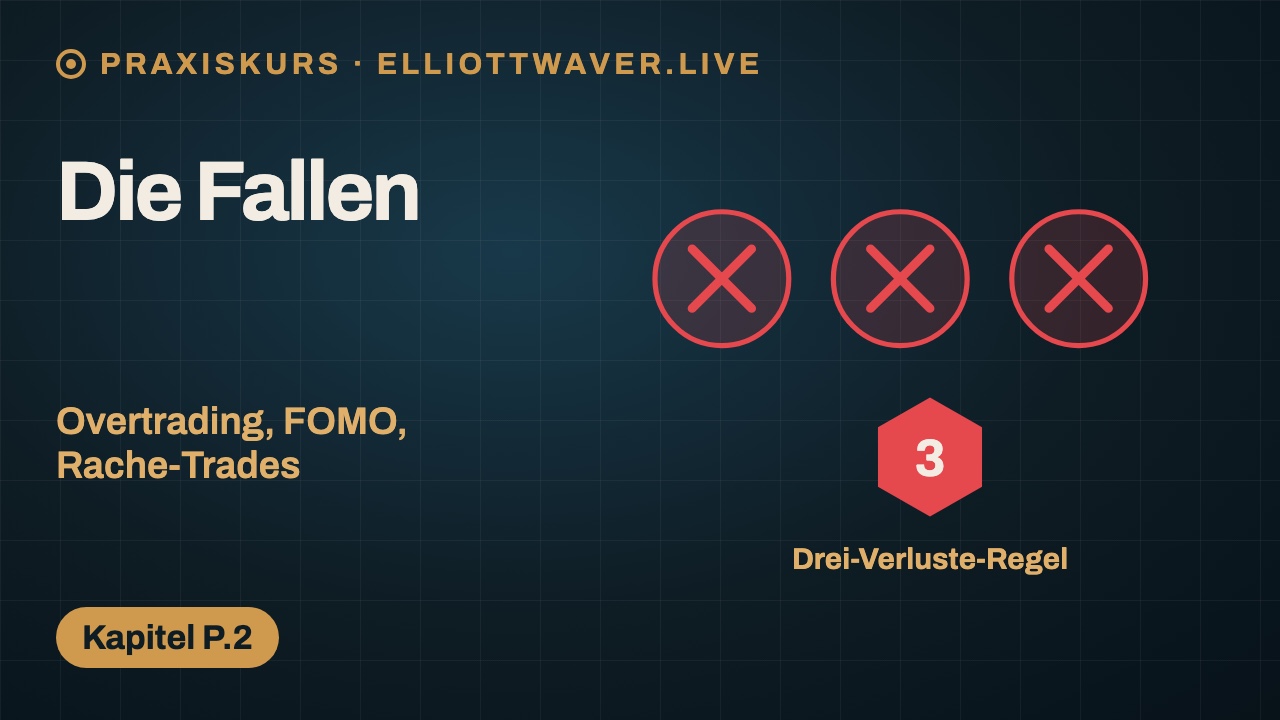
The most common account killers are too many trades, trying to win back losses immediately, and the fear of missing out. Here you'll learn to recognize them and get the three-loss rule as a ripcord for bad days.
Too many trades in too short a time
Overtrading means you no longer wait for clear signals; you jump in at every small move. In the livestream, it looks like this: you enter as soon as an arrow flips somewhere, without the wave count having marked an end of the correction. Or you switch between markets every half hour because something is always going on somewhere.
The result is a chain of many small losses that add up to a big one. On top of that come the costs. Every trade costs you the spread, i.e., the difference between the buy and sell price, from chapter E.2. With three trades a week, you barely notice it; with thirty, it eats up a good chunk of your profits.
The signs
More than three to five trades a day. Trades where one of the two confluences is missing. Trades out of boredom. The feeling of missing out. Constantly jumping between markets.
How you see it in the journal
The number of your trades rises, and the number of check marks on your checklist falls. And the column “Feeling before the trade” more and more often shows “restless” or “bored.”
My livestream method protects you through its very structure. It requires two confluences, a ratio of at least 3 to 1, and an amount that doesn't hurt. Anything that only half fits doesn't make the cut. What's left are a few situations a day, and those are exactly the ones you want.
Wanting to win back the loss immediately
A revenge trade is the attempt to win back a loss immediately. You take a bigger trade without waiting for a signal, driven by frustration and anger. Usually an even bigger loss follows. That increases the frustration further, and you're stuck in a downward spiral.
The insidious thing about the revenge trade: it feels right in the moment. Your brain is looking for a quick solution to the pain of the loss, and a new trade promises immediate relief. That's exactly the point where you stop. Anyone who carries on immediately after a loss is trading on emotion. And trades made on emotion are almost always lost.
A simple calculation shows how fast this happens. Anyone who doubles their size after every loss to catch up faster risks 1, 2, 4, and 8 percent of their account in succession. If they lose all four, 14.3 percent of their account is gone. Anyone who had stayed at one percent would have lost 3.9 percent after the same four losses.
Jumping into a market you'd never trade otherwise after a loss. The DAX stopped you out, and natural gas is moving a lot right now. You don't know its wave count, you don't know how much it fluctuates, and you trade it anyway because you need action now. On an ordinary day, natural gas fluctuates almost four times as much as the DAX, as chapter M.1 shows you. Anyone who enters there with the size of their DAX trades risks a multiple.
The ripcord for bad days
After three losses in a row, you're done for the day. No more trades, no matter how good the next signal looks. Your head is no longer clear. Tomorrow is a new day.My rule
This rule breaks the spiral before it gains momentum. Three losses in a row can happen to anyone, even with a good method. The market moves sideways, the wave count shifts its end of the correction, the arrow flips back and forth. On a day like that, the best trade is the one you don't make.
With a small risk per trade, three losses cost you little. At 1 percent per trade, €10,000 becomes €9,702.99 after three losses, so you've lost just under 3 percent. You win that back almost entirely with a single winner at 3 to 1. Try out in the calculator what it looks like with five, eight, or ten losses, and how fast it goes downhill at 5 percent per trade.
Two paths after three losses of 1 percent each. Green with the three-loss rule and one winner the next day, red with revenge trades at doubled size. The numbers are clickable.
Limits that are fixed before the trading day
At most three trades a day
Set the number before the day begins. Once it's reached, close the livestream and don't look again until tomorrow.
At most three percent daily loss
If you lose three percent of your account in one day, you're done for the day. The three-loss rule also applies, whichever comes first.
The checklist before every trade
Has the wave count marked the end of the correction? Has the arrow come with the close of a candle? Is the ratio at least 3 to 1? Does the amount in euros not hurt? If one box isn't checked, there's no trade.
The journal
Record every trade, with how you felt before and after. After two weeks, you'll see in black and white whether you trade too often. Chapter P.3 shows how to keep it.
Let your alerts call you instead of sitting in front of the screen. Anyone who watches constantly sees a signal in every twitch. How to set the alerts on the arrow-flip lines of your candidates is explained in chapter 1.10.
The fear of missing out
FOMO stands for fear of missing out. You see the Nasdaq rise 500 points, and you're not in. You see Bitcoin make a new high, and you have no position. The feeling is almost unbearable, and it leads you to decisions you'd never make with a clear head.
FOMO makes you enter at the high. When everyone is cheering and the market has already run far, a correction is often imminent. In the language of waves: anyone who buys out of FOMO typically buys in wave 5, the last swing of an impulse, shortly before the whole correction begins. You could hardly find a worse moment.
Red is the FOMO buy at the end of wave 5; green are my method's entries at the end of a correction. The numbers are clickable.
FOMO is fueled by social media and chat groups where others show off their profits. There you only see the winners; nobody shows the losses. Keep in mind: in my 13 markets, there are new opportunities every day. A missed trade in the Nasdaq isn't the end of the world if a clean correction comes to an end in natural gas or Gold tomorrow.
Picking up the breadcrumbs
There's always a next trade
The market offers new opportunities every day, in 13 markets on four timeframes. You don't have to be in on every move.
A missed trade costs nothing
A bad trade costs you money. A missed one only costs you the feeling, and that passes.
Stick to your system
If the confluence is missing, it's not a trade for you. Anyone who chases after the arrow buys at a higher price and with a wider stop.
Think in terms of many trades
A single missed trade doesn't matter over 1,000 trades. Your rules matter in every single one.
“We pick up the breadcrumbs. We don't have to be in on every move. We take the trades our system gives us – and leave the rest.”Frank Schuh
Breadcrumbs sound modest, but over many trades they become a loaf. With a ratio of 3 to 1, €100 risk per trade, and four hits out of ten trades, you lose €100 six times and win €300 four times. The bottom line is €600, even though you were wrong more often than right. For that, you don't need a single trade at the high of a wave 5.
Gold has already risen 3 percent today. In your chat group, everyone is posting their profits. In the livestream, the wave count hasn't marked an end of a correction; the price just keeps running. What do you do?
Deep dive: What buying at the high really costs
Anyone who buys at the end of wave 5 has two problems at once. The first is the stop. It belongs behind the extreme of the last correction, and after a long swing, that's far below the price. With the same euro risk, the position becomes small as a result. The second is the target. After wave 5 comes the correction against the entire move. A target above the high then no longer has any basis in the wave count.
Small position, wide stop, no target: that will never make a 3-to-1 ratio. That's exactly why this trade fails my checklist, and exactly why missing it costs you nothing.
- Overtrading means too many trades without both confluences. Decide before the day: at most three trades, at most three percent loss.
- A revenge trade tries to win back the loss immediately and usually makes it bigger. Anyone who doubles after losses loses 14.3 percent in four trades.
- After three losses in a row, you're done for the day, no matter how good the next signal looks.
- FOMO makes you buy at the end of wave 5. My entries are at the end of a correction.
- A missed trade costs nothing. We pick up the breadcrumbs, in 13 markets, every day.
7 questions about this chapter
Check what you think is right, then tap Evaluate. Below each question, you'll then see why.
The big picture, every trading day
I count 13 markets by hand, on the weekly, daily, 4-hour, and hourly charts, with target, MOB, and trade proposal. You can book one market, a package, or all 13.
Sign up for free and save your progress
You can read everything without an account. With your free account you also get:
- Save your progress and always pick up where you left off
- A quiz with results in every chapter
- A certificate of completion with my signature
- Stay up to date on new lessons, videos, and courses
- €0, no payment details
Register for free
- Save your progress and always pick up where you left off
- A quiz with results in every chapter
- A certificate of completion with my signature
- Stay up to date on new lessons, videos, and courses
- €0, no payment details
Elliott Wave Expert Course
The waves in full depth: 39 lessons with video, exercises, quizzes, and a certificate of completion.
Go to the Expert CourseAs a video course for channel members Google reviews
61 reviews on Google. Did the course help you? Then I'd be glad to get yours.
Write a reviewMy broker
The same spot prices as in the livestream and on my analysis platform. Demo account free of charge.
Open an account with IGOptions and CFDs are complex instruments and come with a high risk of losing money rapidly due to leverage. 74% of retail investor accounts lose money when trading CFDs with this provider. You should consider whether you understand how CFDs work and whether you can afford to take the high risk of losing your money.
15 percent extra
With my code, you get an additional 15 percent on top of the current discounts on the annual and two-year subscriptions.
ELLIOTTWAVER